How Long Does a Water Heater Last in Lake County, IL?
Most tank water heaters last 8 to 12 years, and most tankless units last 20 years or more when they are descaled on schedule. Where yours lands comes down to how hard your water is, how much sediment sits in the tank, and whether the anode rod was ever replaced.
The short answer, by type
Manufacturers do not all publish the same number, and warranty length is not the same thing as service life. Treat these as ranges.
- Tank, gas or electric: roughly 8 to 12 years. Tank warranties commonly run 6 to 12 years. The tank is the part that fails, and once the steel leaks the unit is done.
- Tankless: often 20 years or more. There is no tank to rust through. The heat exchanger is the expensive part, and scale is what shortens its life.
A tank that reaches 12 years and still makes hot water is on borrowed time.
What shortens a water heater in Lake County
Hard water and scale
Heated water leaves its calcium and magnesium behind. In a tank the scale settles to the bottom, and in a tankless unit it coats the heat exchanger.
Most of the county drinks treated Lake Michigan water. The Central Lake County Joint Action Water Agency puts its hardness at about 8 grains per gallon, or 137 mg/L as calcium carbonate, and the Village of Gurnee publishes the same figure and calls the water moderately hard. See the page for plumbers in Gurnee.
Lake Zurich is the exception. It is still on deep wells, and ion exchange treatment installed between 2003 and 2009, mainly for radium, brought hardness down from 14 to 18 grains per gallon in the raw well water to 6 to 8 grains at the faucet. See the page for plumbers in Lake Zurich. On a private well, test rather than assume.
At those levels water here scales a heater over years rather than months. A water softener cuts the mineral load, but CLCJAWA warns that softened water is more corrosive and has been implicated in higher lead and copper levels, and says most residents on lake water stop using softeners.
Sediment in the tank
Minerals and rust settle into the bottom of a tank and insulate the water from the burner, so it runs longer and the steel above it runs hotter than intended. Rumbling or popping is usually sediment, and so is hot water running out sooner than it used to. Draining a few gallons off once a year is common advice, though the interval varies by manufacturer.
The anode rod
Inside a steel tank is a rod of magnesium or aluminum whose job is to corrode so the tank does not, and it protects the tank only for as long as there is rod left. Replacing a spent one is one of the few things that genuinely extends a tank's life. Intervals differ by brand, so ask a plumber rather than assume it is quick.
How to find out how old yours is
There is rarely a plain English build date. Most manufacturers encode the month and year into the serial number on the rating plate, the sticker carrying the model number, capacity, and input rating. Every brand does it differently, so photograph the whole plate and either search the brand name plus "serial number date code" or send the photo with your request and let the plumber read it.
Warning signs it is near the end
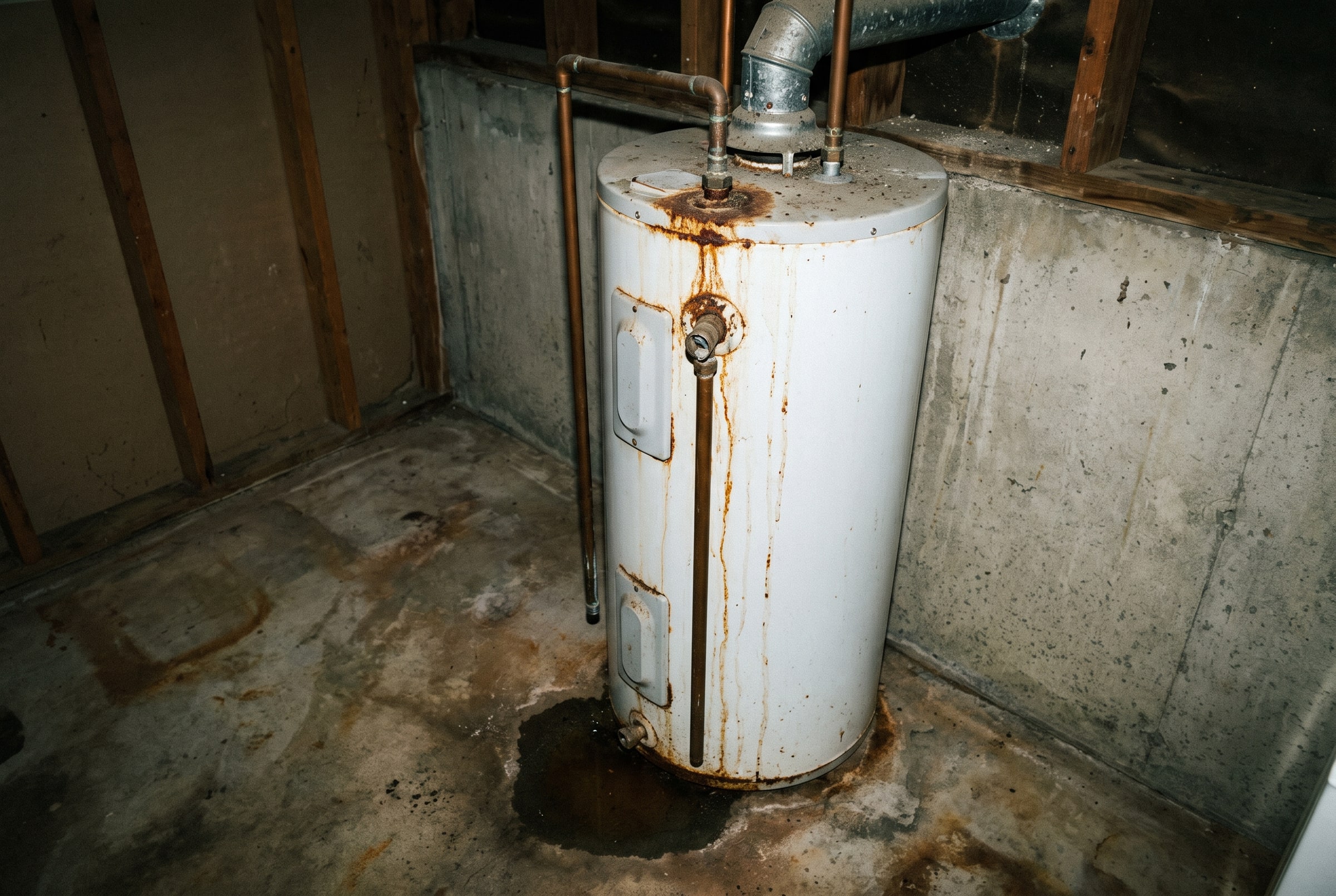
- Water on the floor at the base. Rule out condensation and a dripping relief line first.
- Rust colored hot water that runs clear on the cold side.
- Rumbling, popping, or banging when the burner runs.
- Hot water that runs out faster than it did a year ago.
- Rust or flaking at the fittings, the base, or the flue.
- A relief valve that weeps again after being replaced.
- A burner that will not stay lit, or an electric unit tripping its breaker.
Any of these on a tank over about ten years old is a replacement conversation.
Repair or replace
Plenty of a water heater is repairable. Thermostats, elements, thermocouples, gas control valves, relief valves, and anode rods are all parts, and on a newer unit they are worth fixing. That is the everyday water heater repair work. The tank is not a part. When the steel leaks the unit is finished.
- Under 8 years and not leaking. Repair is usually the sensible call.
- 8 to 12 years. Depends on the failed part. A cheap part on a 9 year old tank is fine. A gas control valve on a 12 year old tank rarely is.
- Leaking from the tank itself. Replace, and find the warranty paperwork first.
Replacing one usually needs a permit
In every Lake County municipality checked for this site, replacing a water heater is permitted work. The details are local.
- Gurnee requires a permit application with the contractor's proposal and a written letter of intent from a licensed plumber.
- Buffalo Grove requires a permit to install or replace a water heater, but not for maintenance or repair. The fee is $65, and an emergency replacement can be permitted within 24 hours after the fact.
- Grayslake requires the permit first, except in an emergency or on a weekend or holiday, when it is obtained the next business day. The form is signed by the owner-occupant and the installing plumber.
The plumber normally pulls it, and an emergency gets a short grace period rather than a pass.
What to put in a request
- The brand, plus a photo of the rating plate.
- Gas or electric, tank size if you know it, and where the heater sits.
- What it is doing and when it started.
- Your town, because the permit office and the rules are local.
- Whether you want a repair, a like for like replacement, or are open to tankless.
What this site does
North Shore Plumbing is not the plumbing contractor. You describe the problem once, a person reads every request, and it goes to a plumber licensed in Illinois who already covers your town. They quote the job and schedule it with you directly. We cannot promise how fast a plumber can reach you, and if we cannot place your request with a licensed plumber who covers your town, we tell you. For anything urgent, do not wait on us. Call a local licensed plumber directly.
If water is spreading near an electrical panel or outlet, or you smell gas, leave the house and call 911 or your gas utility, Nicor Gas or North Shore Gas depending on your town, before calling anyone else.
When you are ready, send a request with the details above.
Questions people ask
Can a water heater last 20 years?
A tank occasionally does, usually on softer water and with an anode rod that was replaced along the way. It is the exception rather than something to plan around. A tankless unit reaching 20 years is far more ordinary, because there is no tank to rust through.
Does a water softener make a water heater last longer?
Less scale reaching the heater means less work for it, which is the argument for one. But CLCJAWA says most residents on its lake water stop using softeners, and warns that softened water is more corrosive and has been implicated in higher lead and copper levels. On well water the calculation is different.
How long can I wait once mine starts leaking?
Treat a leaking tank as a today problem. The failure is in the steel, it only gets larger, and 40 or 50 gallons on a finished basement floor costs far more than the heater. Shut the cold supply valve at the top of the tank, turn off the gas or the breaker, and get it looked at.
