It hums but nothing moves.
The motor has power and the impeller is stuck. Silt, a stone, or a wad of lint, or sometimes air trapped in the pump body.
Sump pump repair, a new pump, or a second pump on a battery. What each one fixes, and what to check in the pit first.
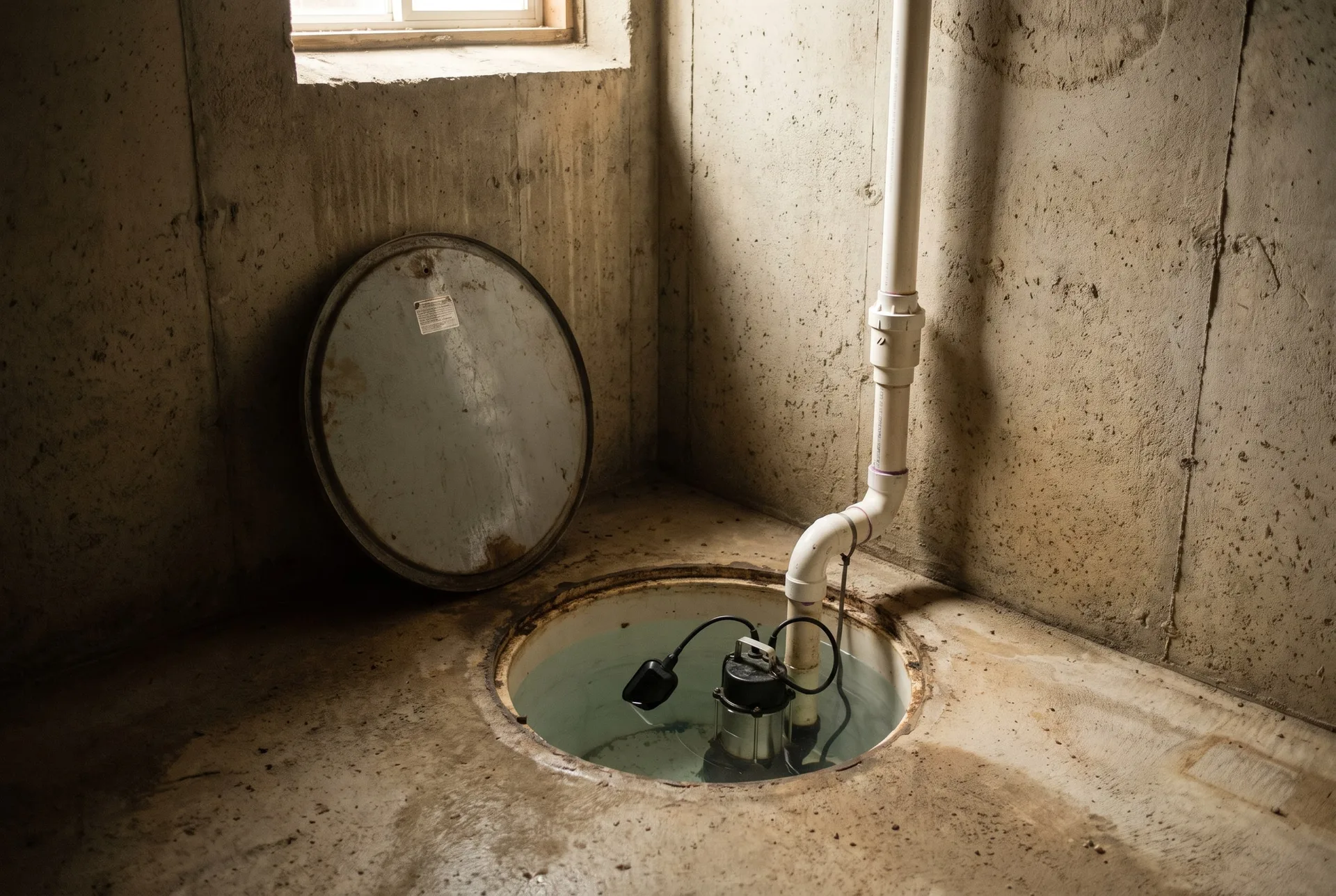
The motor has power and the impeller is stuck. Silt, a stone, or a wad of lint, or sometimes air trapped in the pump body.
Either the float is stuck up, water really is coming in that fast, or the check valve has failed and the same water keeps falling back in.
Check the breaker, the outlet, then the float. A pump on a piggyback float plug can have a dead float and a healthy motor.
The pit is too small, the float is set too low, or the check valve is missing. Short cycling kills a motor fast.
The pump is not the problem. Look at the grade outside, the downspouts, and whether the discharge dumps water back beside the foundation.
Never put a hand in a pit that still has power.
If the motor starts, the float or its switch is the fault and the motor is fine.
A buried, crushed, frozen, or leaf-packed outlet stops a good pump.
Pour a bucket into the pit instead. Running dry burns the seal in seconds.
If water is near the panel, read the shut-off steps on emergency plumber first.
A stuck float, a failed check valve, a blocked discharge, or a tripped outlet are all repairs. If the pump is a few years old and the fault sits outside the motor, fix it.
A motor that has run dry, a seized shaft, a cracked body, or a pump that trips the breaker every time is done. A pump short cycling in an undersized pit will fail again unless the pit is fixed too.
A pedestal pump keeps its motor on a post above the water. It is cheaper, easier to service, and louder. A submersible sits in the water, runs quieter, handles more solids, and is the normal choice under a finished basement. Pit size and how much the noise bothers you decide it.
It buys you the storm that cuts the power, and the night the main pump dies. A backup is a second pump with its own float and a deep cycle battery. It moves less water per minute than the main pump and runs for hours, not days. A water powered backup uses house pressure instead and never needs charging, but it only works on village water.
Pit depth and whether a liner goes in. Horsepower. Whether the discharge has to be re-run or connected to a storm sewer under permit. Whether a backup or an alarm goes in at the same visit.
The Des Plaines River at Gurnee crested at 12.09 feet, above the old record of 11.95 feet from 1986. The National Weather Service put Lake County's damage from that flash flood at $12.70 million. Source for One night in July 2017 reset the records
Libertyville says in its own stormwater plan that it routinely sees local surface flooding once rainfall passes 2 inches, and names 12 chronic problem areas. Source for It does not take a river
Buffalo Grove says a sump pump should not connect to the sanitary line, and wants discharge to the storm sewer or the lawn within 10 feet of the house. A storm sewer connection needs a permit, at a listed fee of $1,200. Source for Where the water may go is a village rule
Sending sump water to the sanitary sewer is a code violation there, with daily fines, and the village rebates 20 percent of the work under its residential disconnection program. Source for Deerfield pays you to disconnect it properly
Discharge rules and flood history change from town to town.
We do not quote, so any number here would be invented. What moves it is whether the fault is the float, the valve, the discharge, or the motor, whether the pit needs a liner, and whether the basement is finished.
A licensed plumber. A float, a plug, or a clogged outlet pipe is within reach of most homeowners, but work on the discharge line or a storm sewer connection needs a permit in most Lake County villages.
There is no single number, because a pump wears by how often it runs. One in a dry basement that starts a few times a month outlasts one near the Des Plaines River that runs daily each spring. Check the date stamp, and treat a pump over ten years old as a candidate rather than a certainty.
For most basements here, nothing replaces it. What helps alongside it is fixing the grade and downspouts, adding a backup and a water alarm, and, for sewage rather than groundwater, a backflow valve. Highland Park reimburses part of that through its sewer lateral cost-share.
North Shore Plumbing connects Lake County homeowners with a licensed local plumber. We are not a plumbing contractor.
Send what the pump is doing and which town you are in. A person reads every request. If we cannot place yours with a licensed plumber who covers your town, we tell you. See how it works.