Every fixture is slow at once.
A single slow sink is a branch problem. The whole house means the fault sits past the point where the branches join.
Sewer line repair starts with a camera, not a guess. Here are the signs, what the camera shows, and how each repair differs.
A single slow sink is a branch problem. The whole house means the fault sits past the point where the branches join.
Water goes in upstairs and comes out at the lowest opening in the house.
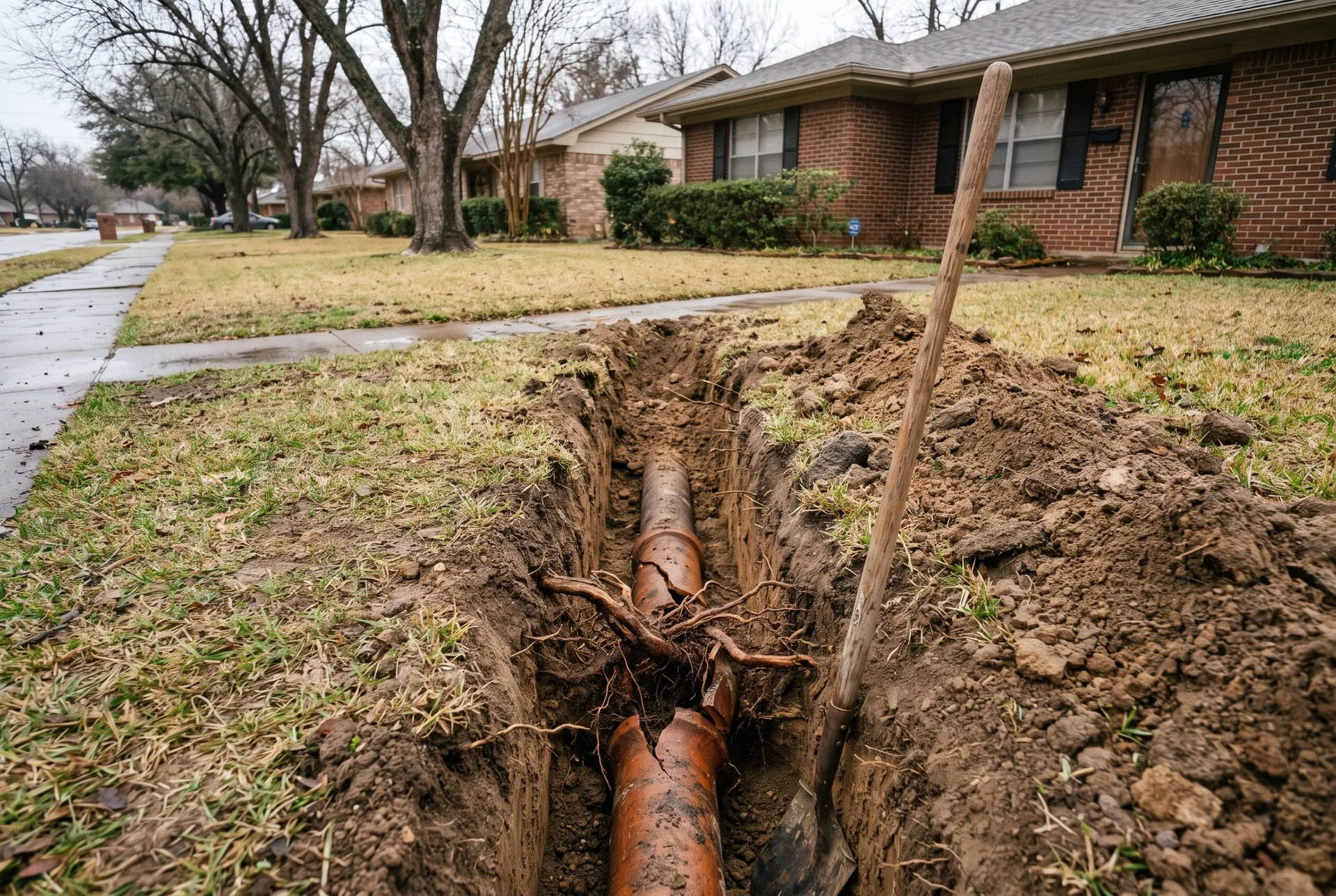
Roots grow back and low spots refill. A fault that returns every spring is a pipe problem, not a blockage.
The village owns the main under the street. You own the lateral running from your house to it.
That split catches people out, because the expensive part is the one nobody thinks about until it fails. So the first useful question is not which plumber, it is whose pipe. Several villages here will check the main before you spend anything.
No washer, no dishwasher, no showers. Every gallon comes out somewhere, and it picks the lowest drain in the house.
Ask public works to check the main. It is free and it settles whose pipe it is.
Keep children and pets out, wear boots and gloves, and open a window.
Chemical cleaner will not touch roots or a collapse, and it makes the pipe dangerous to open.
A cable with a cutting head clears the blockage and shears off roots. It gets the house working again, but it does not fix the crack the roots came through. You are buying months, not years.
A camera on a push rod, with a locator that marks the fault's depth and position in your yard. The only honest way to choose between the three options below. Pay for it first, and ask for the footage.
Dig one hole, cut out the bad few feet, put in new pipe. When the camera shows a single cracked joint or one crushed section at a reachable depth, this is the cheapest real fix. It does nothing for a line failing throughout.
A resin sleeve is pulled into the old pipe and cured hard, making a new pipe inside the old one. Access pits at each end instead of a trench, which is why it appeals when the line runs under a driveway or mature trees. It suits a pipe that is cracked and root-jointed but still holds its shape. It is not for a collapsed pipe, and every branch has to be cut back open afterwards.
Dig the run and lay new pipe, or burst the old one and pull a new one through from pits at each end. The answer for a collapsed line, a bad slope, or a route that has to move. A fair slice of the cost is putting the driveway and planting back.
Depth and length of the run, and what sits on top of it. Whether the work crosses the parkway or the street, which brings a permit and road restoration. Whether the connection at the main has to be remade. Get two quotes on the same camera footage.
In Waukegan, 19.2 percent of homes were built in 1939 or earlier. In Highland Park it is 25.8 percent, and the median home there dates from 1962. Houses of that age commonly have clay tile or cast iron laterals, which is general plumbing knowledge rather than a village record, and clay tile joints are what roots find. Source for A lot of local pipe is old enough to matter
Its voluntary cost-share reimburses up to 20 percent of a private lateral repair or replacement, or an approved backflow device or overhead sewer, capped at $1,260 for single family homes. The city also requires anyone doing lateral work to register as a drain layer and post a $20,000 bond. Source for Highland Park will pay toward the lateral
Village code makes the owner responsible for the service line from the public sewer to the property, and gives 7 days to repair after notice before water service can be stopped. Source for Deerfield puts the duty in writing
Libertyville lists private sewer repair among the permits a homeowner can apply for online. Budget for the permit and inspection. Source for Most of these villages permit the repair
Each town page names who treats the sewage and which office issues the permit.
Call public works and ask them to check the main. Gurnee tells residents to do that before calling a plumber. If the main runs clear, the fault is in your lateral.
Yes, before any repair. Without it you are choosing between a spot repair, a liner, and a new pipe on guesswork, and the gap between those three is large. Ask for the footage so a second plumber can quote on it.
Both are meant to be long-term, and it depends on the host pipe and the quality of the install. Ask each plumber for the written warranty and what voids it, then compare those.
In most of these villages, yes, and the work is usually inspected. Highland Park also wants the contractor registered and bonded.
North Shore Plumbing connects Lake County homeowners with a licensed local plumber. We are not a plumbing contractor.
Tell us which fixtures, how often, and what sits over the line. A person reads every request. If we cannot place yours with a licensed plumber who covers your town, we tell you. See how it works.