Hard water is back.
Spotting, no lather, scale returning. Either the resin is exhausted, the unit has stopped regenerating, or someone left it in bypass.
Water softener installation starts with your own hardness number, and across much of Lake County that number is moderate. Here is how to decide, and what to do when the one you have stops working.
The regional supplier that treats Lake Michigan water for Libertyville, Gurnee, Grayslake, and Mundelein puts hardness at about 8 grains per gallon. Gurnee repeats the same figure on its own site. Source for Most of the county drinks moderately hard lake water
The city publishes 7.5 grains per gallon from its own lake plant. Source for Lake Forest is slightly softer
Village wells once ran 14 to 18 grains per gallon. Treatment put in between 2003 and 2009, built mainly for naturally occurring radium, brought that down to 6 to 8 grains. The village calls the result very soft and says a softener there is personal preference. Source for Lake Zurich is the well water town, and it already treats it
At 8 grains per gallon, a softener here is a comfort decision rather than a rescue.
That is not what the water treatment companies who own this search will tell you. The supplier says this water holds almost no iron and does not typically clog pipes. What 8 grains does do is leave spots on glassware, film in the kettle, stiffer laundry, and more soap for the same lather. Plenty of people find that annoying enough to fix, which is a fair reason and a different one from a well at 20 grains that really does ruin fixtures.
Softening has trade-offs too. The same supplier notes that ion exchange swaps hardness for sodium, and that softened water is more corrosive and has been implicated in higher lead and copper readings. In a county where Waukegan still counts roughly 9,000 lead service lines, that is worth knowing first.
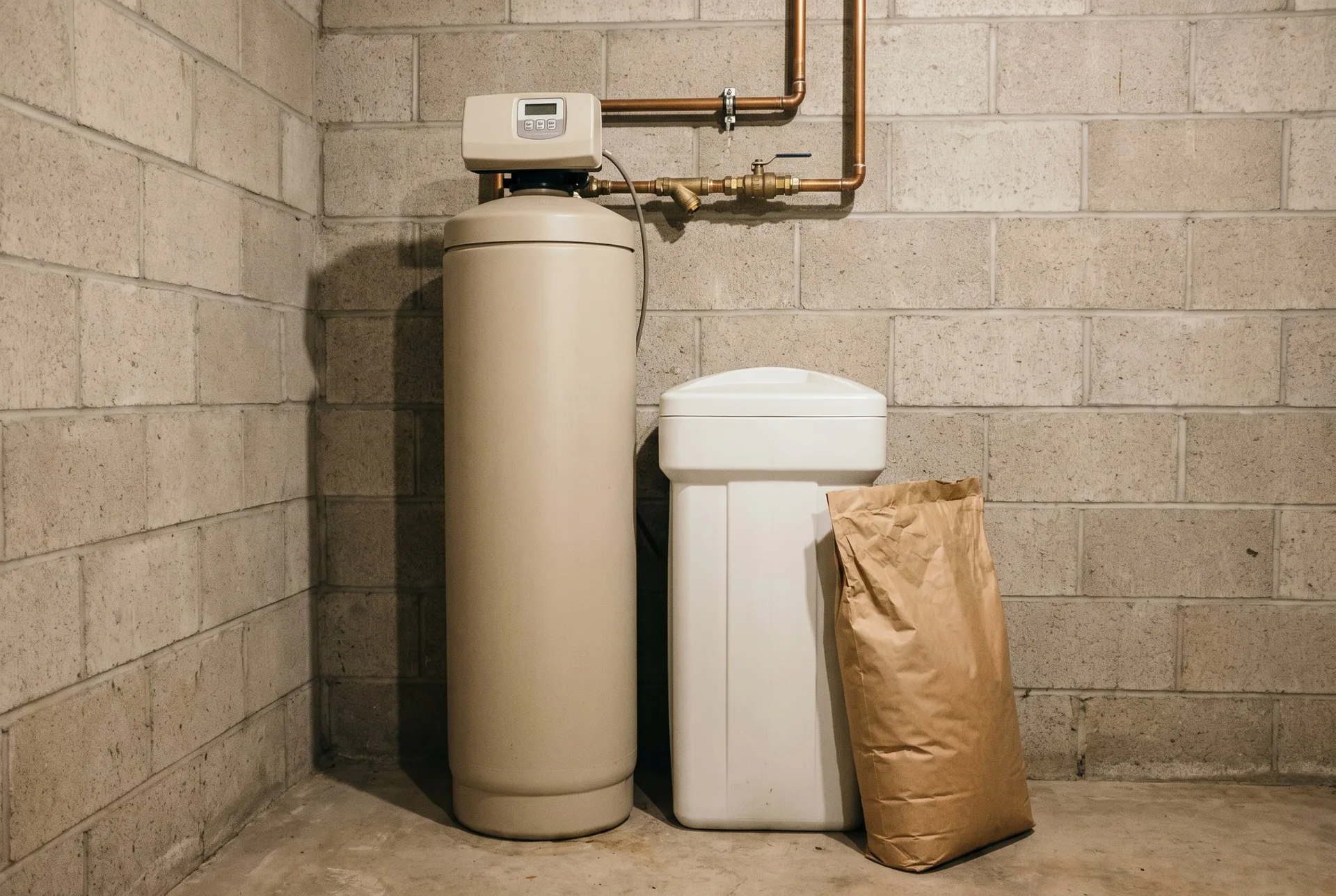
The only device that actually removes hardness. Water passes through a resin bed that swaps calcium and magnesium for sodium. Every few days it regenerates, rinsing the resin with brine and flushing the waste to a drain. It needs salt carried in and a drain to send brine to.
These do not remove hardness. They change how the minerals behave so scale is less likely to stick, and the water still tests hard afterwards. On 8 grain lake water, if all you want is less scale in the kettle and the heater, that can be enough, and there is no salt and no drain line. If you want soft water on your skin, it will disappoint you.
Sizing is arithmetic, not a sales pitch. Take your daily water use from the water bill, multiply by hardness in grains per gallon, and you have your daily grain load. The unit is then chosen to regenerate every few days rather than every day. Ask any installer to show you that sum.
Nobody needs softened water on the lawn, and the heater is the appliance hardness costs you money in. See water heater repair for what scale does to a tank.
Regeneration brine has to go somewhere. The discharge sits above the drain with a gap, so nothing can siphon back into the softener. This is the part people get wrong.
The bypass keeps water on while the unit is serviced. Salt bags are heavy, and a softener at the bottom of steep stairs is a decision you regret monthly.
Spotting, no lather, scale returning. Either the resin is exhausted, the unit has stopped regenerating, or someone left it in bypass.
A salt bridge. It looks full while the brine underneath is gone, so the softener regenerates with plain water and does nothing.
The brine is not being drawn. Usually the injector, the safety float, or a blocked drain line.
A failed control head, a dead timer, or a rinse cycle that is not finishing. On an older unit this is where repair starts losing to replacement.
Each town page lists the water source, the hardness figure where the village publishes one, and the permit office.
On lake water at about 8 grains per gallon, no, not to protect your house. It is a comfort choice. On a private well in an unincorporated township the answer is often yes, and a hardness test comes first.
It adds sodium, in proportion to how hard the water was. Libertyville's water report lists sodium at 10 ppm before any softening and flags it for anyone on a low sodium diet. Many people leave the kitchen cold faucet unsoftened.
The regional supplier says softening increases the corrosivity of water and has often been implicated in raised lead and copper readings. If your home still has a lead or unknown service line, raise that with the plumber first.
A control head, injector, float, drain line, or seals are normal repairs. Age plus a cracked tank or a resin bed fouled with iron tips it to replacement. Ask for the fault to be named first. "It is old" is not a diagnosis.
Ask your village. Lake Zurich makes adding or altering a plumbing appliance a permit item, and villages here want a licensed plumber named on any plumbing permit. A softener ties into the main supply and needs a proper drain, so it is plumbing work either way.
North Shore Plumbing connects Lake County homeowners with a licensed local plumber. We are not a plumbing contractor.
Tell us your town, and whether this is a new softener or a repair. A person reads every request. If we cannot place yours with a licensed plumber who covers your town, we tell you. See how it works.